Thursday, May 16, 2013

A glance of the water cycle through a different perspective...


I recently discovered an amazing website that gives access to tons of information through interactive activities and prompts.  In my exploring of this website, I discovered a wonderful post pertaining to the water cycle.

This information contained in the smartnotebook was very accurate.  I found the information to be very age oriented and created on a level that was considerate of all children's learning styles.   This obviously contributed to the overall goal of the lesson being met. 
In addition, not only did this lesson give children a chance to ponder on vocabulary terms such as evaporation, condensation, precipitation, etc.  It also in turn stated terms and then gave a visual demonstrate of the term and an example. 
The use of this program was very easy and created around the concept of student interaction.  There were slides available for the students to come to the board and write, move, label and demonstrate different concepts based on their knowledge, which I find much more beneficial than completing a worksheet. 
 There were portions of this slideshow that allowed for children to even give examples and not examples and how to decipher between the two in relation to the water cycle. A game was even presented that allowed the children to roll a die and the number the die landed of depicted what vocabulary term the student would have.  The student would then give a brief explanation as to how their vocabulary term was associated with the water cycle. I love this idea.  Not only having the children interact with the material,  but with each other is an excellent idea.  
This lesson as a whole was amazing.  The interaction with the technology that the children would receive through this, is exceptional.  The content and materials found within this lesson is accurate and very interactive.  The entire concept of the water cycle can be slightly difficult, however through this material.  The students are given the opportunity to explore the water cycle in several different ways, all of which would give the students a lasting and effective understanding of the concept.  
The only portion of this lesson I would possibly change would be the closure.  There was to true sense of closure found the the ending of the presentation.  As a future educator, I am well aware of just how important it is to close a lesson with students in order for them fully grasp and conceal a concept.  However, I really did enjoy this lesson regardless and would definitely recommend this site and particular presentation to any teacher introducing the water cycle.  


Sunday, May 12, 2013

You Tube, TeacherTube and Google


YouTube, Teacher Tube and Google are all excellent way to help aid in teaching a lesson.  However, there are pros and cons to each.  In this blog, I will be exploring the differences of each and the concerns versus the importance of each.  


As an instructor my main concerns with viewing YouTube and Google Videos is the presence of advertisements.  Sometimes inappropriate adds appear on these sites that, as a teacher, I would not want my students to view, much less in my own classroom.  
Teacher Tube is a wonderful site.  I love the effectiveness and content within this site.  The value of this site is wonderful, with the many ways to teach and view material with students to help convey thoughts and ideas.
Integrating TeacherTube would be very easy to do. When teaching a concept, videos and clips are a wonderful way to capture students attention and connect them with the material in way that could not be accomplished otherwise.  In many of my own lesson plans, The Magic School Bus videos have been as excellent way to integrate technology into a lesson.  These videos really get the students imagination going and they are excited to learn in the process, which makes the teaching even more effective.

Voice Thread


Voice Thread is a website that allows individuals to create a document containing a visual representation accompanied with a verbal explanation of that visual.  When I first entered into this site I was a little confused and frustrated, only due to my lack of knowledge with the sight.  However, after completing the creation of my own voice thread, I found the software and website very easy to operate.  Therefore, I would say I did like and enjoy this technological learning experience.


The value in Voice Thread, I believe is giving individuals as actual voice to speak with rather just through typing words onto a computer screen.  This allows the viewer to get a better understanding of the tone and ideas the publisher wants to express without misinterpreting written information. 
At the beginning of creating my account with Voice Thread, I did have some confusion with how to create, upload and record, only to to my own lack of knowledge with the site.  However,  I  did not encounter any technical problems using this tool and actually found it rather simplistic after the voice thread was completed.
This could be a wonderful tool used to teach students How To assignments.  The students could be giving a How To, to complete and using their voice in a voice thread they could demonstrate their How To.  As well, this could be an amazing tool to utilize to provide experience when giving speeches.  Recording them playing back your own voice thread, could give valuable insight into things to change and how to make a speech better, before having to actually present it.   These are just a few of many instanced where this tool could be implemented into a classroom.  Obviously, the age level of children would be a key concept to consider when using this tool, but as a whole, I feel this could be a very beneficial tool to many age levels.  

Technological Diversities


Technology is a forever changing concept in our society.  From cell phones to highly intellectual software devices technology is all around us in diverse ways and forms, whether we realize it or not.  This is something I have always been aware of however, I did not realize that the vast differences present in internet technology.  When the concept of the internet is brought to my mind I simply think, search engines such as Google, informational websites such as CNN, WALB etc., social networking sites such as Facebook or MySpace, videos sources such as YouTube, etc.  What I lacked knowledge in was just how different these versions are and how they originated.  The true differences in these different sites are the versions in which they are considered.  There is Web 1.0 and Web 2.0. Web 1.0 is more of an informational based website.


In Web 1.0, information is usually used and placed on a site for nothing more than the purpose to inform.  There is no commenting or editing that takes place after a story or column has been placed on a website such as WALB or CNN, which is why these sites are considered under the Web 1.0 category.  Another form of information, in a different form of advertising is Craigslist, this website is used to find and search for information on buying and selling products.  As web 1.0 sites are based more around information, usually anyone can view or enter the site without log in information. 
Other sites such as Facebook or MySpace, are considered in the Web 2.0 category.  Web 2.0 is a more lenient site form that gives the consumer a way creating the site more to his/ her liking.  The flexibility of these sites gives the consumer the options to add photos, videos, comment, friends etc.  Web 2.0 is a very functional and social networking form of site.  These sites consider log in and passwords in order to enter into the site and usually have constant update and changes to the site for customer satisfaction.
I would definitely say that Web 2.0 is the form of internet I use more often, with Facebook and schooling.  However, the availability of Web 1.0 is very useful.  For research, or just simple informational purposes, Web 1.0 is very functional and useful source as well. I believe both versions, Web 1.0 and Web 2.0, are very important attributes to technology. In both instances, as a teacher I could definitely see myself implementing both versions of the Web into my future classroom with myself as well as, with my students.  

Tuesday, April 23, 2013

What if you lived during the Civil War?


What if you lived during the time of the Civil War?  Wouldn't it be amazing to look through a window and be able to picture the way life during that time frame?  If you answered yes to this question then you are going to fall in love with the book, “If you Lived at the Time of the Civil War.”  This amazing short story is written by Kay Moore and beautifully illustrated by Anni Matsick.
This book begins with an introduction to the Civil War, when it took place, how it started and who was involved.  Each of these points is defined through a question style of writing. The author gives specific as well as interesting facts that would really capture student’s attention.  Maps and correlating keys are even illustrated within the book to visually allow students to see which states were the Confederate States and which states were the Union States.
As well as all of the above information this book also states facts as to what the Union Army was like verses the Confederate Army.   And even gives insight into what the battle fields would have been like.  There are detail explanations as to how families, crops, schools and homes were affected by the Civil War and how things drastically changed.
Finally, this book sums up the Civil War by giving clarification to how the aftermath of the Civil War took a toll on both the North and the South and how families dealt with such changes. 
This book is full of information and even gives specific locations to visit as a field trip or even as a family vacation that are historic landmarks from the Civil War time frame.


Obviously, this would be an wonderful book to incorporate during a Civil War Unit.  The content in this book is unlimited and fun of wonderful ideas and ways to incorporate the theme of the Civil War in a fun and exciting way that could and would really engage students of any age group.  This would be a great addition to anyone classroom library! Hope you enjoy!

Wednesday, April 10, 2013

Addition Mission!!!

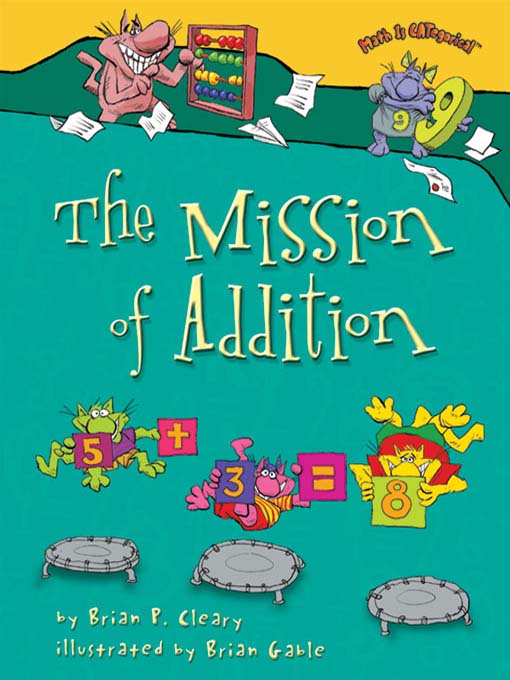
Mathematics is a content area almost every child struggles with at some point in his or her lifetime.  So as a future educator I asked myself, why not make elementary mathematics a fun area for children to explore?  To do so, I found an amazing fiction story titled "The Mission of Addition" written by Brian P. Cleary.  Cleary is so clever in this cute book, where he takes the reader on a journey through addition problems that children see in everyday life.  
For example:
 "6 yellow buses were parked in a line.  3 pulled behind and them and then there were 9." 
 The rhyme and riddles that go along with the story line of addition is fascinating.  There are several examples children could read in this book that they could relate to real life situations.  Another example in this book, reads about the Johnson family.  
"The Johnsons' had 1 babysitter Gretchen was her name.  She cried "Help!" So number 2, Miss Higgenbottom came....5th was Caitlyn Macnamee and 6th was Mr. Lee, and 4 more totalled 10 in all to watch that crew of 3."
Giving these situations where addition is used is a fun way of not only telling what addition means and entails but also gives the read a look into how easy addition can really be.  Through these pages, in almost every instance, the writer refers to addition in other terms such as, plus or and which is a huge aspect in expanding vocabulary as well as understanding addition . 
I would definitely recommend this book for any math lesson that deals with adding obviously, but I would also recommend it to be incorporated when teaching children about word problems.  This story is a excellent example of how word problems work.  This book I believe would really excite the children because it almost takes them on a journey through all of these different addition experiences and does so in a fun way.  Hope you enjoy and add this to your book collection!  

Tuesday, April 9, 2013

Water, Water Everywhere!

Saving water is a concept that many misunderstand or are even uninformed about its importance.  The book "Saving Water" is a cute story/ information text written by Neil Morris.  This book is a non-fiction book based on facts about the importance of where water comes from, all the uses of water, dirty water, and most importantly collecting and recycling water.  In the end of this book there is even a section of notes for parents and teachers.  There are many sections of this book with captions of "DID YOU KNOW?"  these sections are filled with creative ways of introducing concepts with fun facts about water, such as "Did you know...2/3 of our body is made of water." or "It is impossible to think of a drink without water!" There are even captions that contain fun experiments such as, "You can do it...you can see how much rain falls by leaving an empty pot, such as a glass jar, outside."  These fun experiments would even be fun activities to do in the classroom setting on a rainy day.   


Saving water is a wonderful science concept to introduce to children.  Not only the fun facts but lessons that can be brought about by this book are unlimited.  This book is filled with content and information that children of all ages could understand and find interesting.  Some lessons for example would be the life cycle of water or even the importance of recycling and conserving water.  I would defiantly recommend this book to be added to a classroom library for any age group.  Hope you enjoy! 


Tuesday, April 2, 2013

How Do You Feel Today?

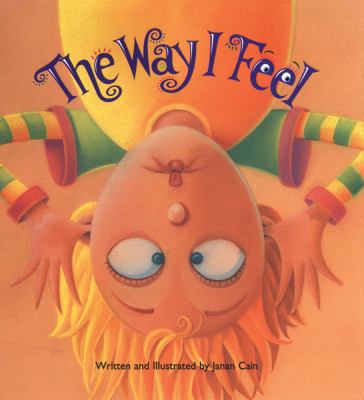
Have you ever really considered how many different emotions and feelings you go through in one day? I know I, personally, go through more than I can count. There are moments in the day where I am excited about something, angry at something, sad about something.  Although, I am award of the different emotions I feel and can understand what emotions are young children are unsure of what exactly to call the feeling that they experience.  Therefore, a wonderful way to introduce and explain the concept of feeling I have chosen the cute fiction book, "The Way I Feel".
"The Way I Feel", is written and illustrated by Janan Cain.  Not only are the illustrations spot on in their message but the flow or words and explanations of feeling is exquisite.  This story uses all different characters and settings, with the turn of each page, to explain and give meaning to the different feelings we have. One page reads,
"I'm shaking because I am SCARED.  All alone in the dark at night.  The thunder and lightning crash and roar!  Hold me close and turn on the light!"
 This is just one of the many examples this book gives on the different feels we have.  And not only are the explanations of the feelings accurate they are realistic and give realistic situations that any child and/ or adult could relate to.


In order to introduce this concept and make a lasting impression, I chose the strategy f making an accordion book.  Making an accordion book is basically where the child will fold a sheet of paper into an accordion style shape then write or draw something from the book on each individual fold.  This strategy would open up so many doors for children to write about all of the different feelings in the book but as the teacher,for this particular book I would defiantly recommend drawing a picture to represent the different  feeling and giving that feeling a face to associate it with, just as the book did with its illustrations.  The children's explainations and drawings from this book would be amazing.  We go through so many different emotions it would be exciting to have the children share the way they feel about certain things and how certain things make them feel. 
I really enjoyed this book because it is a great read and a fun way to bring about the concept of feelings.  I would defiantly recommend this book and will use this book and strategy in my future classroom to incorporate and explain feelings! :)  


Tuesday, March 26, 2013

Have you ever wondered what happened to the Itsy Bitsy Spider, after he/she climber up the water spout again?

The selection for today's blog is a fiction book, written as an addition to the renowned story of "The Itsy Bitsy Spider."  Written by Iza Trapani, "The Itsy Bitsy Spider" is a wonderful children's story that not only tells the historical story of the Itsy Bitsy Spider climbing up the water spout, but the story also tells the following journeys the Itsy Bitsy Spider experiences.  For example,
"The Itsy Bitsy Spider
Climber up the kitchen wall.
Swoosh! went the fan
And made the spider fall."
This is just one example how the story leads into the spiders life after the water spout.  Not only does this book introduce a new concept of the Itsy Bitsy Spider, but it also exercises rhymes and patterns with words.


Reading the story of "The Itsy Bitsy Spider" is not only a cherished childhood memory for myself but it is one I would enjoy passing on to future generations as well.  Therefore, my passing on of this story would be in a play writing strategy.  For this strategy, the children could use the examples this story gives to what happens to the Itsy Bitsy Spider, or create there own ending as to what happened to the spider and act that ending out with the classroom.  This activity would be very exciting to see what their little imaginations would come up with as the story but also as to how they would act their stories out.  In creating their own versions of, "The Itsy Bitsy Spider" The children would also be exposed to rhymes and creating a poet rhythm.

In its entirety, I love the whole concept of this book and the twist it gives on the classic story of "The Itsy Bitsy Spider".  We all know how much we love acting out just one version of this classic story so why not change the game up a little and venture out into the life of "The Itsy Bitsy Spider" through play writing.

Tuesday, February 26, 2013

Manners, Please?

Today's book choice is "Manners on the Playground", written by Carrie Finn and Illustrated by Chris Lenseh.  This sweet picture book not only incorporates the content of manners but it does so in a way that children can relate to in everyday situations.
This story begins with the line"The playground is for everyone", the continues in a manner that pulls children into the story, because we all know how much children love their playground time.  After capturing the children's attention the book says, "There are lots of ways you can use good manners in the play ground."  Then as you flip the pages the book gives real life examples of children taking turns, saying "Thank you", listening to the teacher's instructions, sharing, team work, good sportsman ship, saying "Please", helping each other, saying "Excuse me", cleaning up, and most importantly playing safely.
As you can see this story gives many ways to use good manners and does so, using instances that children could face on the playground. This concept was not only brought down to a children's level of understanding, but it was done so in a way that children could really relate to their own playground experiences.
This story was not only a great way to incorporate the concept of manners but it also can be used to establish rules and playground manners that must be used when playing, to avoid hurting feeling or one another.
Since this book can be so easily related to children's personal experiences  I choose the sketch-to-stretch strategy to use with the book.   To do this activity I would read the story aloud to the classroom, then ask the children to individually draw what the story meant to them.  Whether, they had experiences like the ones the characters had in the book, or whether they have had an opportunity where they could have used better manners.  After the children have completed their drawings the teacher could ask for volunteers and either have the children tell about the story or even act it out, as if they were really on the playground.  This activity and book could not only encourage students but it would also reinforce the importance of using good manners.

As well, there are also many other books such as this one, where the use of good manners are incorporated in real life experiences. :) ei.  Manners at a Friends House, Manners at School, etc.all written by the same author.

Sunday, February 17, 2013

Have you used your senses today?

Do you know what the five senses are?  Have you even wanted to learn more about them while venturing on a delightful journey, with the famous Ms.Frizzle?  Written by Ioanna Cole and Bruce Degen, the non-fiction information book The Magic School Bus - Explores the Senses, is a refreshing way to explore and/or teach the concepts about our senses.  
This book, although it has fictional characters the material and concepts of the senses are very factual and full of information for children to learn about in a fun way.    The Magic School Bus stories are known for their adventures.  So would you like to take a guess at where The Magic School Bus will be headed today?


The eye is the first destination for Ms. Frizzle and the children.  Entering through the cornea, the iris and finally through the pupil.  "Frizzle Fact - When the muscles of the iris tighten, the pupil gets smaller.  Then less light enters your eye.  When the muscles relax,the pupil gets larger.  More light gets in."  another fun fact that their adventure entailed was the meaning of the word "iris"  Iris comes from a word that means "rainbow."  A rainbow has lots of colors, just as the Iris in our eyes come in many colors too.  I thought this was pretty interesting the way the detailed the factual information in a fun way that would allow children to grasp the concepts a little easier.  Their journey continued as they entered the inside of the eye and related it to a camera.  This again, gave detailed factual non-fiction information on the eye in a way that gives children a visual illustration of what it would be like in the actual eye.  There are also detailed captions on each page that give cute facts as well.  For example, "Actual size: The retina in your eye is no thicker than a page in this book!" I thought this was neat because the children could hold a sheet of paper and visualize the size of their own retina, and making the learning engaging for kinesthetic learners.  
This is the journey obviously through the sight sense.  The other senses are explored as well, in the same manner.  All of the details and explanations on the senses are very vivid and detailed in a child friendly manner.  
I would defiantly recommend this book to a teacher, mother, father, or parent who is trying to teach a lesson to children about what the senses are, what they are made of, and how they work.  This book not only gives an excellent representation of each sense, but it does so in a way that really captures the attention and gives fun facts that allow the learning to be a fun and memorable journey through the senses.  

Saturday, January 26, 2013

Have you "cried wolf" lately???

Hi!

Traditional literature is the topic of today's lovely book.  Traditional literature is really a beautiful addition to any book collection.  As a mere piece of history in a sense, traditional literature, has and still does, capture the hearts of children, even adults, in the fascinating story tales, creative characters, and underlying lessons.

Traditional literature being my book study of today, I chose the book, "The Boy Who Cried Wolf" adapted by Jennifer Boudart and Illustrated by Jon Goodell.


This historic tale of honesty is about the journey of a shepherd boy who learns a lesson the hard way.  Little Timothy was known for the love and care he took up with the sheep of the town.  Although he loved tending the sheep he often got lonely in the big meadow all alone.  So, one day he had an idea, if he called for help he wondered if all the townsmen would come.  Therefore, little Timothy called out "Help! Help! A wolf is after the Sheep!"  All the men in the town came running to help Timothy, only to discover that there was no wolf.  Only Timothy laughing at all the men.  He thought it was hilarious that they had all got so nervous.  Then Timothy realized what he did was wrong and promised not to do it again.
A few days later Little Timothy was saddened and angry that no one was worried about him.  He wanted to be important just like the sheep so he called out, "Help! Help! A wolf is after the sheep!" The townsmen came running only to discover disappointment in Timothy.  He had lied again.  The townsmen told Timothy "We told you not to play tricks but you didn't listen. Maybe next time we won't believe you if you call for help!"
Timothy then realized what he had done was very wrong.  So, he tended the sheep very well over the next few days.  One day he heard a strange noise, a noise he had never heard before, coming from the sheep.  He  looked and it was a real WOLF!  Timothy called out, "Help! Help! A wolf is after the sheep!"  But no one believed him and he could not fight off the wolf alone.  He ran for help yelling again "Help! Help! A wolf is after the sheep!" Everyone just laughed at Timothy.  When Timothy returned the wolf was gone and so were all of the sheep.  Little Timothy learned a very valuable lesson that day.  He learned if you want to be trusted, you must always be HONEST!

I love this particular piece of traditional literature.  How about you?  Not only does this story incorporate a story line but it also could be used in a classroom to teach children the importance of honesty.  Elementary aged children aren't aware of the true importance of telling the truth.  This story could be a great way to teach them the same lesson that Timothy learned, while entertaining them as well.

As a teacher you could possibly even sequence the story with the children and show the causes and effects of the choices Timothy made. You could also have the children tell what he could have been done differently to change the fate of the poor sheep.

Altogether, this story receives an excellent rating for it's wonderful lesson.  What better way to share and teach children the true importance of honesty than with literature. :)

Tuesday, January 22, 2013

Is There Really A Human Race?

Hello again!

For my first children's literature blog I am analysing children's poetry.  For my poetry book analysis, I choose the book, "Is There Really A Human Race?".  This children's story is written by Jamie Lee Curtis and Laura Cornell.  Both Authors are very fascinating and unique in their approach to literature and their concepts of the world, as they take us on a journey through the question, "Is There Really A Human race?".  Let your mind wonder and enjoy!

"Is There Really A Human Race?", really captured my attention due to the reality it brings to life.  Not only does this book give an alternate representation to the human race, it does so in a poetic, comical and creative way.  By questioning the human "race" as if it were a marathon, the authors make us in turn question the human "race" as a population of different ethnicity's.  The authors of this book brought the aspect of race into the picture but also questioned the reality of the human race in a way that showed us how we all have the same equivalency in the difference we can make, no matter our race.  This was a very imaginative twist brought to life, in how we should treat one another fairly and should work together in order for us to come together and create a beautiful world.

This sweet story begins with a little boy asking the questions:

"Is there really a human race?
 Is it going on now all over the place?
 When did it start?
 Who said, "Ready, Set, Go?"
 Did it start on my birthday?
 I really must know."

With these questions our little adventurer is off.  Asking questions and pondering answers about this human "race", which he has never heard of before.  In the ending, this young boy discovers that the human "race", is relishing the journey and making the right choices, because how "we" as a human race live and love is how we learn to make the world a better place, ironically one small "step" at a time.

"So, take what's inside you and make big, bold choices.
 And for those who can speak for themselves,
 Use bold voices.

 And make friends and love well,
 bring art to this place,
 And make the world better,
 For the whole human race."

How sweet this ending is.  The irony of the story is that the little boy is in search of something completly different, when he discovers a life lesson and learns to strive for the best he can be.  This story could not only be used for entertainment purposes but for behavioral and even educational purposes in reguards to how we should treat one another everyday and in everyway. 


Wednesday, January 16, 2013

Introduction

Hello.
I am currently working on my BS in Early Childhood Education. I am taking a Children's Literature class and as part of this class I am blogging about a children's poetry book.  Hope you enjoy and feel free to leave comments and/ or recommendations.