Thursday, May 16, 2013

A glance of the water cycle through a different perspective...


I recently discovered an amazing website that gives access to tons of information through interactive activities and prompts.  In my exploring of this website, I discovered a wonderful post pertaining to the water cycle.

This information contained in the smartnotebook was very accurate.  I found the information to be very age oriented and created on a level that was considerate of all children's learning styles.   This obviously contributed to the overall goal of the lesson being met. 
In addition, not only did this lesson give children a chance to ponder on vocabulary terms such as evaporation, condensation, precipitation, etc.  It also in turn stated terms and then gave a visual demonstrate of the term and an example. 
The use of this program was very easy and created around the concept of student interaction.  There were slides available for the students to come to the board and write, move, label and demonstrate different concepts based on their knowledge, which I find much more beneficial than completing a worksheet. 
 There were portions of this slideshow that allowed for children to even give examples and not examples and how to decipher between the two in relation to the water cycle. A game was even presented that allowed the children to roll a die and the number the die landed of depicted what vocabulary term the student would have.  The student would then give a brief explanation as to how their vocabulary term was associated with the water cycle. I love this idea.  Not only having the children interact with the material,  but with each other is an excellent idea.  
This lesson as a whole was amazing.  The interaction with the technology that the children would receive through this, is exceptional.  The content and materials found within this lesson is accurate and very interactive.  The entire concept of the water cycle can be slightly difficult, however through this material.  The students are given the opportunity to explore the water cycle in several different ways, all of which would give the students a lasting and effective understanding of the concept.  
The only portion of this lesson I would possibly change would be the closure.  There was to true sense of closure found the the ending of the presentation.  As a future educator, I am well aware of just how important it is to close a lesson with students in order for them fully grasp and conceal a concept.  However, I really did enjoy this lesson regardless and would definitely recommend this site and particular presentation to any teacher introducing the water cycle.  


Sunday, May 12, 2013

You Tube, TeacherTube and Google


YouTube, Teacher Tube and Google are all excellent way to help aid in teaching a lesson.  However, there are pros and cons to each.  In this blog, I will be exploring the differences of each and the concerns versus the importance of each.  


As an instructor my main concerns with viewing YouTube and Google Videos is the presence of advertisements.  Sometimes inappropriate adds appear on these sites that, as a teacher, I would not want my students to view, much less in my own classroom.  
Teacher Tube is a wonderful site.  I love the effectiveness and content within this site.  The value of this site is wonderful, with the many ways to teach and view material with students to help convey thoughts and ideas.
Integrating TeacherTube would be very easy to do. When teaching a concept, videos and clips are a wonderful way to capture students attention and connect them with the material in way that could not be accomplished otherwise.  In many of my own lesson plans, The Magic School Bus videos have been as excellent way to integrate technology into a lesson.  These videos really get the students imagination going and they are excited to learn in the process, which makes the teaching even more effective.

Voice Thread


Voice Thread is a website that allows individuals to create a document containing a visual representation accompanied with a verbal explanation of that visual.  When I first entered into this site I was a little confused and frustrated, only due to my lack of knowledge with the sight.  However, after completing the creation of my own voice thread, I found the software and website very easy to operate.  Therefore, I would say I did like and enjoy this technological learning experience.


The value in Voice Thread, I believe is giving individuals as actual voice to speak with rather just through typing words onto a computer screen.  This allows the viewer to get a better understanding of the tone and ideas the publisher wants to express without misinterpreting written information. 
At the beginning of creating my account with Voice Thread, I did have some confusion with how to create, upload and record, only to to my own lack of knowledge with the site.  However,  I  did not encounter any technical problems using this tool and actually found it rather simplistic after the voice thread was completed.
This could be a wonderful tool used to teach students How To assignments.  The students could be giving a How To, to complete and using their voice in a voice thread they could demonstrate their How To.  As well, this could be an amazing tool to utilize to provide experience when giving speeches.  Recording them playing back your own voice thread, could give valuable insight into things to change and how to make a speech better, before having to actually present it.   These are just a few of many instanced where this tool could be implemented into a classroom.  Obviously, the age level of children would be a key concept to consider when using this tool, but as a whole, I feel this could be a very beneficial tool to many age levels.  

Technological Diversities


Technology is a forever changing concept in our society.  From cell phones to highly intellectual software devices technology is all around us in diverse ways and forms, whether we realize it or not.  This is something I have always been aware of however, I did not realize that the vast differences present in internet technology.  When the concept of the internet is brought to my mind I simply think, search engines such as Google, informational websites such as CNN, WALB etc., social networking sites such as Facebook or MySpace, videos sources such as YouTube, etc.  What I lacked knowledge in was just how different these versions are and how they originated.  The true differences in these different sites are the versions in which they are considered.  There is Web 1.0 and Web 2.0. Web 1.0 is more of an informational based website.


In Web 1.0, information is usually used and placed on a site for nothing more than the purpose to inform.  There is no commenting or editing that takes place after a story or column has been placed on a website such as WALB or CNN, which is why these sites are considered under the Web 1.0 category.  Another form of information, in a different form of advertising is Craigslist, this website is used to find and search for information on buying and selling products.  As web 1.0 sites are based more around information, usually anyone can view or enter the site without log in information. 
Other sites such as Facebook or MySpace, are considered in the Web 2.0 category.  Web 2.0 is a more lenient site form that gives the consumer a way creating the site more to his/ her liking.  The flexibility of these sites gives the consumer the options to add photos, videos, comment, friends etc.  Web 2.0 is a very functional and social networking form of site.  These sites consider log in and passwords in order to enter into the site and usually have constant update and changes to the site for customer satisfaction.
I would definitely say that Web 2.0 is the form of internet I use more often, with Facebook and schooling.  However, the availability of Web 1.0 is very useful.  For research, or just simple informational purposes, Web 1.0 is very functional and useful source as well. I believe both versions, Web 1.0 and Web 2.0, are very important attributes to technology. In both instances, as a teacher I could definitely see myself implementing both versions of the Web into my future classroom with myself as well as, with my students.  

Tuesday, April 23, 2013

What if you lived during the Civil War?


What if you lived during the time of the Civil War?  Wouldn't it be amazing to look through a window and be able to picture the way life during that time frame?  If you answered yes to this question then you are going to fall in love with the book, “If you Lived at the Time of the Civil War.”  This amazing short story is written by Kay Moore and beautifully illustrated by Anni Matsick.
This book begins with an introduction to the Civil War, when it took place, how it started and who was involved.  Each of these points is defined through a question style of writing. The author gives specific as well as interesting facts that would really capture student’s attention.  Maps and correlating keys are even illustrated within the book to visually allow students to see which states were the Confederate States and which states were the Union States.
As well as all of the above information this book also states facts as to what the Union Army was like verses the Confederate Army.   And even gives insight into what the battle fields would have been like.  There are detail explanations as to how families, crops, schools and homes were affected by the Civil War and how things drastically changed.
Finally, this book sums up the Civil War by giving clarification to how the aftermath of the Civil War took a toll on both the North and the South and how families dealt with such changes. 
This book is full of information and even gives specific locations to visit as a field trip or even as a family vacation that are historic landmarks from the Civil War time frame.


Obviously, this would be an wonderful book to incorporate during a Civil War Unit.  The content in this book is unlimited and fun of wonderful ideas and ways to incorporate the theme of the Civil War in a fun and exciting way that could and would really engage students of any age group.  This would be a great addition to anyone classroom library! Hope you enjoy!

Wednesday, April 10, 2013

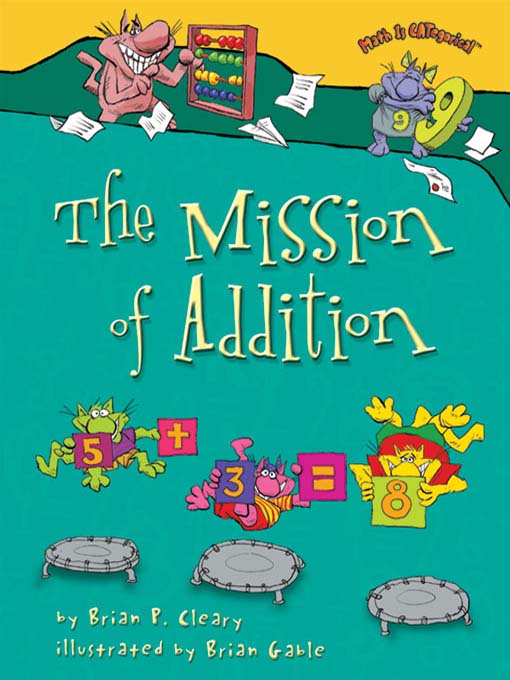
Addition Mission!!!

Mathematics is a content area almost every child struggles with at some point in his or her lifetime.  So as a future educator I asked myself, why not make elementary mathematics a fun area for children to explore?  To do so, I found an amazing fiction story titled "The Mission of Addition" written by Brian P. Cleary.  Cleary is so clever in this cute book, where he takes the reader on a journey through addition problems that children see in everyday life.  
For example:
 "6 yellow buses were parked in a line.  3 pulled behind and them and then there were 9." 
 The rhyme and riddles that go along with the story line of addition is fascinating.  There are several examples children could read in this book that they could relate to real life situations.  Another example in this book, reads about the Johnson family.  
"The Johnsons' had 1 babysitter Gretchen was her name.  She cried "Help!" So number 2, Miss Higgenbottom came....5th was Caitlyn Macnamee and 6th was Mr. Lee, and 4 more totalled 10 in all to watch that crew of 3."
Giving these situations where addition is used is a fun way of not only telling what addition means and entails but also gives the read a look into how easy addition can really be.  Through these pages, in almost every instance, the writer refers to addition in other terms such as, plus or and which is a huge aspect in expanding vocabulary as well as understanding addition . 
I would definitely recommend this book for any math lesson that deals with adding obviously, but I would also recommend it to be incorporated when teaching children about word problems.  This story is a excellent example of how word problems work.  This book I believe would really excite the children because it almost takes them on a journey through all of these different addition experiences and does so in a fun way.  Hope you enjoy and add this to your book collection!  

Tuesday, April 9, 2013

Water, Water Everywhere!

Saving water is a concept that many misunderstand or are even uninformed about its importance.  The book "Saving Water" is a cute story/ information text written by Neil Morris.  This book is a non-fiction book based on facts about the importance of where water comes from, all the uses of water, dirty water, and most importantly collecting and recycling water.  In the end of this book there is even a section of notes for parents and teachers.  There are many sections of this book with captions of "DID YOU KNOW?"  these sections are filled with creative ways of introducing concepts with fun facts about water, such as "Did you know...2/3 of our body is made of water." or "It is impossible to think of a drink without water!" There are even captions that contain fun experiments such as, "You can do it...you can see how much rain falls by leaving an empty pot, such as a glass jar, outside."  These fun experiments would even be fun activities to do in the classroom setting on a rainy day.   


Saving water is a wonderful science concept to introduce to children.  Not only the fun facts but lessons that can be brought about by this book are unlimited.  This book is filled with content and information that children of all ages could understand and find interesting.  Some lessons for example would be the life cycle of water or even the importance of recycling and conserving water.  I would defiantly recommend this book to be added to a classroom library for any age group.  Hope you enjoy!